Showing posts with label Columbia River. Show all posts

10 February 2026

Two Boulders, Seeming So

It is possible that to seem—it is to be,
As the sun is something seeming and it is.


The sun is an example. What it seems
It is and in such seeming all things are.


Thus things are like a seeming of the sun
Or like a seeming of the moon or night 


Or sleep.

— Wallace Stevens

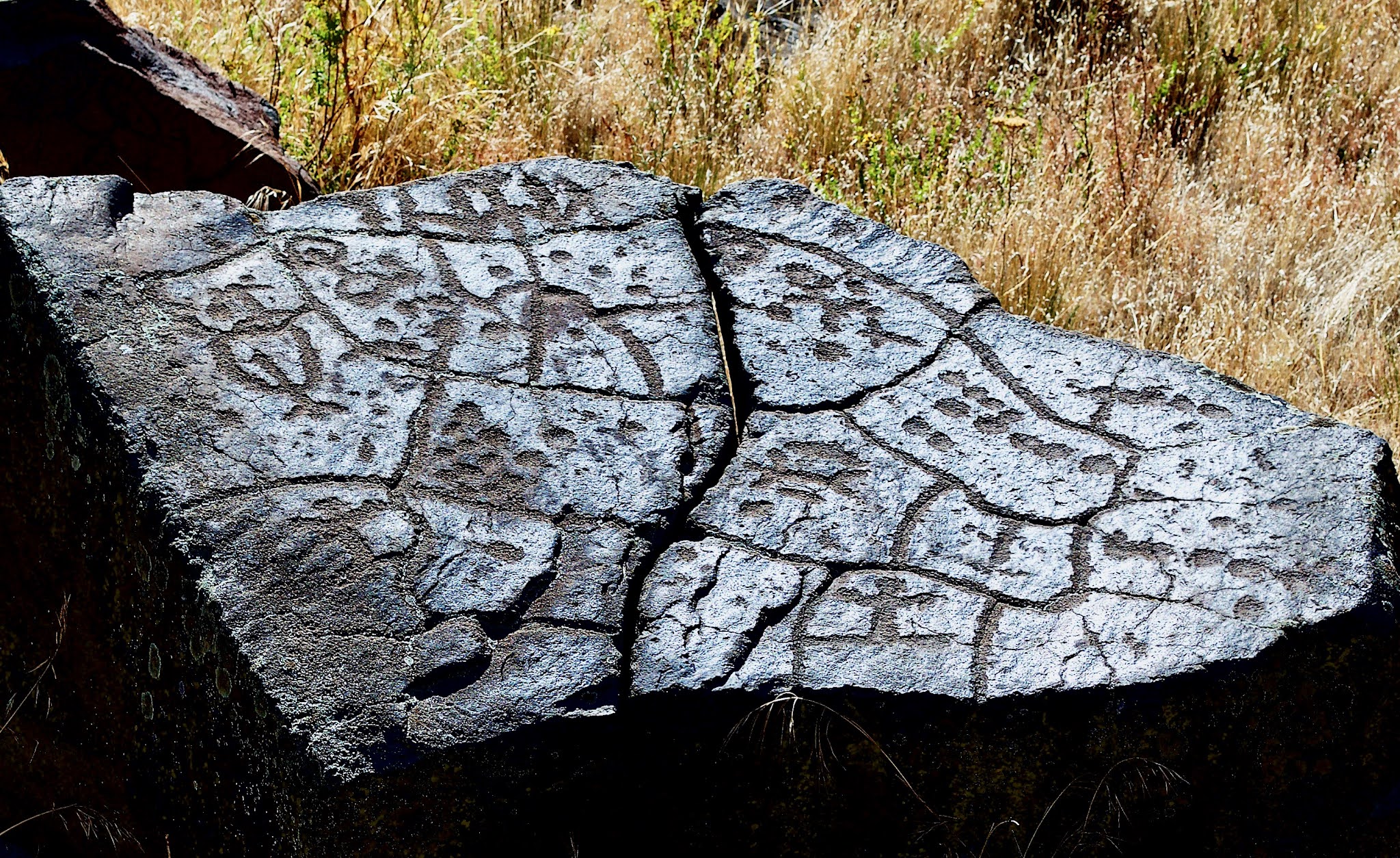
ABOVE: An old-style boulder moved from the edge of the lower Columbia River, as Bonneville Dam was constructed, to a plaza in front of the county courthouse at Stevenson WA.  
So it seems:  The Garrison Eddy Petroglyph Boulder
...

There might be, too, a change immenser than
A poet’s metaphors in which being would


Come true, a point in the fire of music where
Dazzle yields to a clarity and we observe,


And observing is completing and we are content,
In a world that shrinks to an immediate whole,


That we do not need to understand, complete
Without secret arrangements of it in the mind.

—Wallace Stevens

...
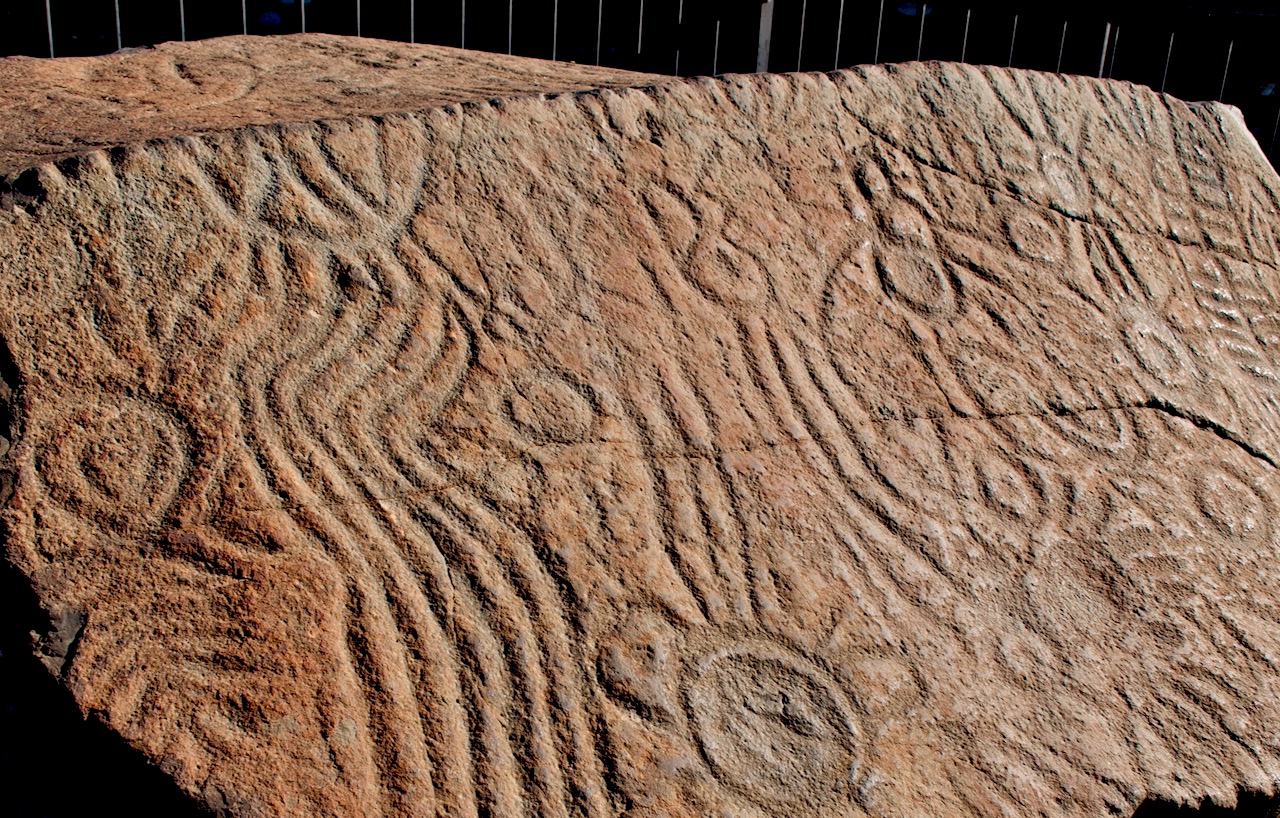
BELOW:  Near a road winding east in Mendocino County to the Elk River, with over a dozen concentric circles carved in bas relief, this boulder considered an example of the some of the oldest rock art in the Northwest.
So it seems:  The Spyrock Petroglyph Boulder
Hundreds of miles apart, these two boulders bearing carvings which appear to be related traditions. I speculate early peoples traveled along the coast and explored up rivers. Perhaps settling, or moving on, maybe disappearing. But in these attentive instances, they left their marks.

These concentric circular motifs seem to speak of water.  Perhaps of cycles, of seasons, in memory. A bringing forth from and with stone. As invocation. We cannot know.

All photos: Douglas Beauchamp
In flat appearance we should be and be, 

Except for delicate clinkings not explained.

These are the actual seemings that we see,
Hear, feel and know. We feel and know them so.

—Wallace Stevens


(All Stevens excerpts from the poem Description Without Place)

It is a sense


To which we refer experience, a knowledge
Incognito, the column in the desert,


On which the dove alights. Description is
Composed of a sight indifferent to the eye.


It is an expectation, a desire,
A palm that rises up beyond the sea,


A little different from reality:
The difference that we make in what we see


And our memorials of that difference,
Sprinklings of bright particulars from the sky.


The future is description without place,
The categorical predicate, the arc.

—Wallace Stevens

05 April 2024

Swallowing II: A Singular Petroglyph Boulder


Nature is a temple where living pillars
Sometimes let out confused lyrics
Man passes through, across forests of symbols
Each one observing him with a familiar gaze

Like long echoes, from afar confounding
In a dark and profound unity
Vast like night and like clarity
Fragrance, color, and sound all resounding
    Charles Baudelaire, 1857

1953. Five Mile Rapid, Swallowed in 1957
Near the lower end there are several dangerous rocks in the rapid, and at the foot large masses of rock divide it into different parts the main channel empties into a capacious, deep basin of rectangular shape, called Big Eddy.   
-- Captain. Chas. F. Powell, Corps of Engineers, 1882
1954. Boulder during evaluation by archaeologists

The investigation of the petroglyphs (in spring 1956) was made by Samuel C. Sargent, a Geologist with the Corps of Engineers, on The Dalles Dam project. Mr. Sargent called attention to petroglyphs existing on islands in Fivemile Rapids, which can be easily removed and are in an excellent state of preservation. These petroglyphs are located in areas 6 and 7. I would urge that these petroglyphs be salvaged, since they represent unique forms for this area. 
-- David L. Cole, University of Oregon, 1956

In attempting to raise the petroglyph from Area 7 (by the Corps of Engineer’s Derrick Barge “Cascade” after the formation of The Dalles Dam Pool), the connection to the lift line parted and the petroglyph and lift line were lost. In the near future, an attempt will be made to recover the petroglyph with the help of a diver.
-- Joseph F. Garback, Lt Colonel, Corps of Engineers, 1957

1956. Army Corps of Engineers assessment for relocation

Area 7 was on a small island at the lower end of Fivemile Rapids. One rock was to be removed from this island. This rock was approximately seven feet high, eight feet wide and eight feet deep, weighing approximately seventeen tons. It was lying loose on a level area. Jacks were used to lift the rock enough to slip the cables under … the petroglyph was … bound with a cable which was attached to a float. In the attempt to lift this petroglyph a cable clamp slipped and it fell back into the water. The last report received was that the Corps of Engineers planned to send a diver down after it.
-- David L. Cole, University of Oregon, 1958

The Columbia River today pooled by The Dalles Dam

It is unfortunate that the petroglyph from Area #7 was lost in the efforts to raise it from the bottom of the pool. Naturally, $1,000 to attempt to recover this petroglyph is out of line with the value of the petroglyph, and we feel that this petroglyph will have to be considered as lost.
-- Herbert Maier, National Park Service, 1958

Dislocated from one another, we are now flooded,
resting in place.
We suffocate in the backwater of decadence
and fractious contempt.
Purity of the ancient is the language without tongues.
The river elegantly marks swirls on its surface,
a spiral that tells of a place
that remains undisturbed.
— Elizabeth Woody 

NOTES
— Charles Baudelaire from the poem Correspondences in Les Fleurs du mal, 1857. Translated by Ariana Reines.
— Elizabeth Woody from her poem “Waterways Endeavor to Translate Silence from Currents” in Luminaries of the humble. U of Arizona Press, 1994.
— In 1956 a cast of this petroglyph was made by James Hansen for the Oregon Museum of Science and Industry (OMSI) in Portland. Also in 1956, a rubbing made by Sari Dienes is now in the archives of the Burke Museum in Seattle.
Other NOTES & References available on request

16 March 2024

Columbia River Petroglyph: The Swallowing

In 1956 artist Sari Dienes draped burlap of over a boulder and, using a brayer, produced a stone “rubbing” with red and black paint —  an image of petroglyphs.

Dienes produced another rubbing of this boulder on paper with black ink now archived at the Burke Museum in Seattle along with several hundred other petroglyph rubbings completed under a contract. 

This distinctive figure is described as a “monster” and its design elaborated in 1956 notations by Mark Hedden. A reductive -- and misleading -- labeling seems to me.  Several versions of cautionary stories of indigenous river peoples do tell of a swallowing monster in the depths of the river.  A leap from those often terrifying stories to conjuring this spirited figure carved in stone as monster.   


A real swallowing concrete monster in 1956 was under construction:  The Dalles Dam on the mid-Columbia River which the following year devoured miles of canyon, traditional fishing places, ancient villages, untold graves — and hundreds of the petroglyphs of the mid-Columbia River. 

Above, the boulder face:  64” wide, 40” high. The primary figure (top) is 32” in height. Below, another detail.

NOTES

— The stone rubbing: red and black in on burlap, 64” wide, 40” high. The primary figure is 32” in height. A gift to us from the family of David Cole, an archaeologist who worked on contract with the Army Corps of Engineers in the mid-1950s.

— Curiously, without explanation, a Burke Archaeology article was titled:

“Sea Monsters and Mountain Sheep: Preserving Images of Columbia River Rock Art.” We are left to imagine what the writers imagined… as the river ripples on...

Sari Dienes, a prolific, daring and eclectic artist had done manhole covers in New York City and in 1956 recently completed street rubbings in Oakland CA. Her petroglyph rubbings from the Columbia River were exhibited that year in San Francisco at the Palace of the Legion of Honor. Next, she traveled to Kyoto Japan and produced other petroglyph rubbings.

http://saridienes.org/life/1940-1959.html

https://www.moma.org/artists/8085

https://en.wikipedia.org/wiki/Sari_Dienes#Sidewalk_Rubbings

https://vimeo.com/859777002

— Notably, in the1920s, surrealist artist Max Ernst explored frottage (rubbing on textured surfaces) as the basis for an multitude of drawings and paintings. Dienes, born in 1898 in Hungary, would have known of Ernst's work.

https://www.moma.org/collection/terms/frottage

Sari Dienes at work on the Columbia River, 1956.

14 March 2023

Wallula Stone: Petroglyph Boulder Thrice Displaced

Wallula Stone (detail)
Below: Columbia River near Wallula Gap, Washington-Oregon border.
2013 Photos DB
The Wallula Monolith "discovered" 1897 by a railroad crew. Displaced to Portland City Hall plaza in 1910.  Below: Portion of the boulder partially chalked, shown with Frederic Saylor, who analyzed and wrote in detail his speculative imaginings re its meaning.  
The boulder, supine 1910-1940, displaced pillar-like in 1940 (photo Ben Maxwell circa 1950) with an attached bronze tablet (Photo DB, 2013)
In 1996, fortuitous circumstances resulted in the Wallula Stone repatriated and again (dis)placed to the new Nix-Ya-Wii Warriors Memorial, honoring tribal veterans of all wars and of the signers of the Treaty of 1855, at the Confederated Tribes of the Umatilla Indian Reservation (CTUIR), Mission, Oregon..
In situ photos above and below at the Warriors Memorial, 2013 (DB)
View online or download the complete 2013 presentation as a PDF from Academia, click link: Versions and Variations of the Storied Wallula Stone, 1897-2012.  Research presented by DB at the Northwest Anthropological Conference, Portland, OR. March 2013.

30 June 2022

What Does Lizard Know? 3

Lizard knows patience. 

Desire.  

Lizard knows they are not lizards.  

Lizard-becoming knows stone. 

Crackings. 

Darkness bright; stillness glimpsed.  

Cracklings.

Lizard sees you seeing.

iPhone photos (above)

Adapted from Woodward (1982) who claims “emergent lizard”

Adapted from Keyser and Poetschat (2004) who claim “spirit helper”


Not-lizard guesses a percent of reptile-extinction embodied in reciprocal recognition


You see Lizard seeing You

Not saying what cannot be said

Lizard not quaintly “emergent”

Lizard ain't no-body's “spirit helper”

Lizard-becoming as close as Dare.

iPhone photo (above) edited in DStretch, modified in MacOS Photos


Lizard sees you seeing.

Sees the attention economy.

The roll-on Columbia River.

The pulsing surge of server farms.

Dairy farms. Wind farms.

Lizard stopped counting eons.

Glacial floodings energy channeled.

Concreted dammings power corridored.

BPA budget borrowings corrupted.

Salmon lusting, waning, wallowing.…  


Lizard knows The Swallowing.

Columbia River as Lake behind The Dalles Dam

In the distance The Dalles and Mt Hood 


Lizard considers Critical Theory.

Seriously considers:

Philosophers, psychologists, and theorists of social interaction have long understood that recognition is crucial to Lizard flourishing. The idea that we can only be fully lizard if we are recognized by others is a central theme of the tradition of political thought, in which the political sphere is conceived not as an empty stage for individual pursuits but as a common realm in which we first appear to one another and find our completion as earth beings.

Google Data Center at The Dalles, courtesy Google

 Photos by Douglas Beauchamp except as noted, click to enlarge.

NOTES

— Recognition paragraph above borrowed, with three alterations, from:  “In Search of Recognition,” a review by Peter E. Gordon of Recognition: A Chapter in the History of European Ideas by Axel Honneth, in the New York Review of Books, June 23, 2022.


— Previous What Does Lizard Know? posts:

March 23 2022: 

https://rockartoregon.blogspot.com/2022/03/what-does-lizard-know.html

May 1 2022:

https://rockartoregon.blogspot.com/2022/05/what-does-lizard-know-ii.html


Lizard ran out on a rock and looked up, listening
no doubt to the sound of the spheres. 

— DH Lawrence

06 December 2021

Glyphland: A maze-like journey

“Rock inscriptions at Roosevelt, Washington, except for one maze-like inscription covering several square feet of rock surface, are nondescript and have apparently little value as an archeological key.” — Herbert Krieger, Ethnologist, 1927 Columbia River survey for the Smithsonian
Glyphland: The strange story of a century of speculation and promotion, and the unlikely journey of the Roosevelt, Washington, petroglyphs.

In sum…
In the early 1920s an Oregon newspaper announced discovery of “Picture Writings” near Roosevelt, Washington, on the Columbia River. A popular 1921 volume, Oregon, provided drawings of petroglyphs from the site. In 1928-1929 The Oregon State Motor Association promoted it as destination for vacationers, via ferry from Arlington, Oregon.
Thus began “Glyphland” and nine decades speculation, promotion, displacement, and documentation. The John Day Dam project in the 1950s and 1960s sparked relocation of 27 of the riverside basalt boulders to a civic park near Roosevelt. After forty years and visits by thousands, neglect motivated a 2003 move under the auspices of the Army Corps of Engineers, in consultation with tribal and park representatives, to Horsethief State Park (now Columbia Hills), across from The Dalles, Oregon. 
In 2012 these 27 boulders, cleaned then moved again, joined other petroglyphs displaced by The Dalles Dam in the 1950s to become part of the Temani Pesh-wa Trail. Today this display, along with the nearby Tsagiglalal petroglyph, is a popular heritage attraction.
"maze-like" boulder situated at Horsethief State Park since 2012 -- its fourth move since the 1960s.
(Figures lower right also originally from Columbia River near Roosevelt.)